
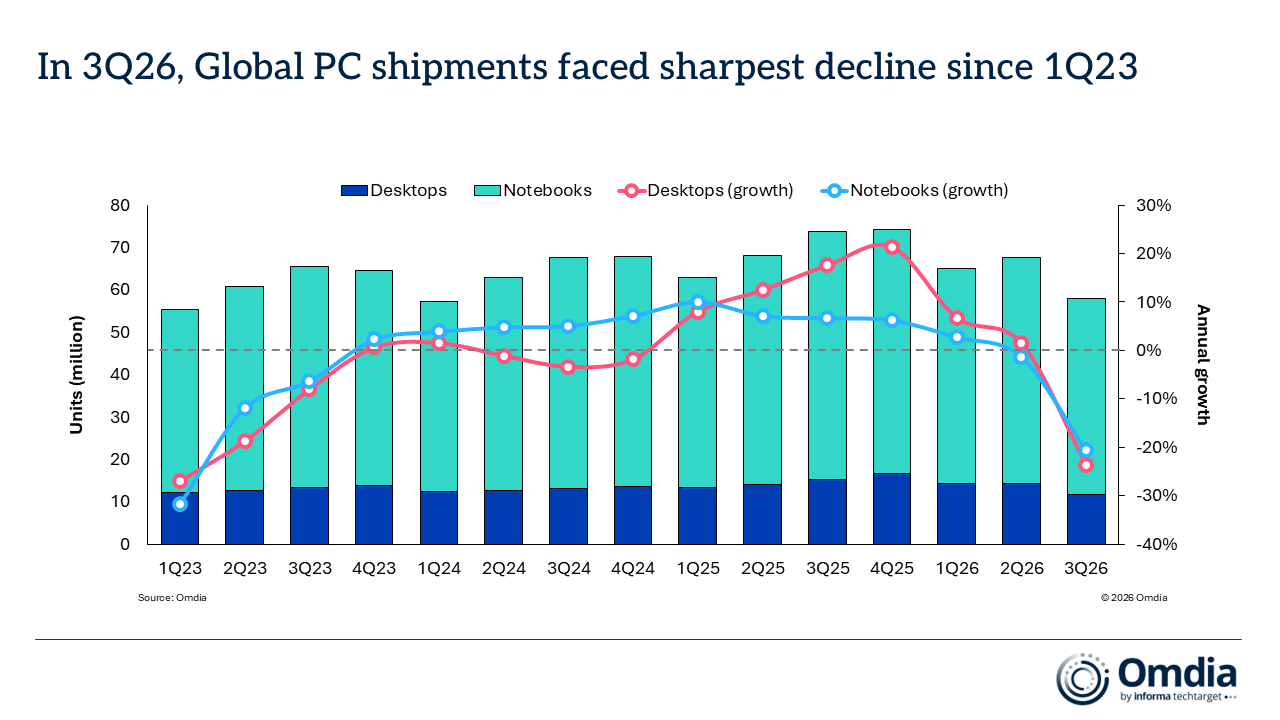
PC shipments saw a steep drop of about 20 percent in Q3 2026, analysts reported this week.
The industry saw its “sharpest decline since “Q1 2023,” Omdia said in an announcement toady. Global shipments of laptops, desktops, and workstations fell 21.2 percent year over year (YoY) to 58.1 million devices, the analyst said.
Desktop PC shipments (including desktop workstations) decreased 23.5 percent to 11.7 million units, and laptop shipments (including laptop workstations) declined 20.6 percent to 46.4 million, per Omdia.
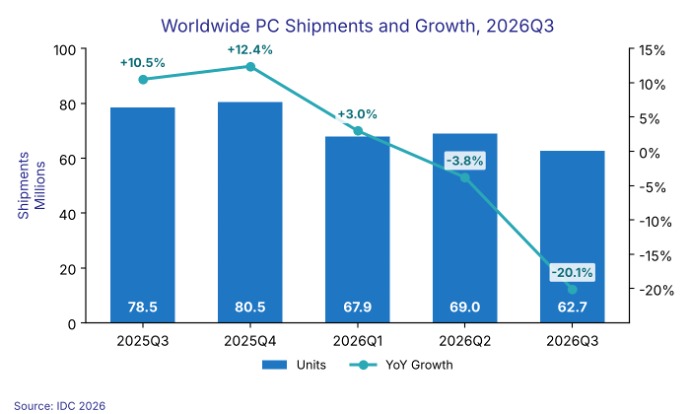
IDC shared similar findings. The analyst said this week that PC shipments fell 20.1 percent YoY to 62.7 million units, compared to 78.5 million in Q3 2025.
The industry also shipped 9.1 percent fewer PCs in Q3 2026 than it did in Q2 2026, when 68.2 million units shipped, per IDC.
The 20.1 percent YoY decline is the biggest drop that the IDC has ever recorded during a year’s third quarter, the IDC said, per PCMag.
The drop in shipments is also notable considering that Q3 PC shipments usually surpass Q2’s numbers.
“If looking at all quarters, then we have seen other quarters in recent years with larger declines, such as 2022 Q4, which was -28.2 percent, and 2023 Q1, which was -28.7 percent. Both were coming off pandemic highs,” Jitesh Ubrani, research director for consumer devices at IDC, told PCMag.
In its announcement this week, IDC said that many PC vendors and sales channels stocked up on PC shipments earlier in the year in anticipation of memory price hikes. That meant minimal demand remained during Q3.
“[Sales] channels are now worried about carrying too much inventory into a market where high prices are suppressing demand,” Ubrani said in a statement.
“That could translate into promotions and some short-term relief for consumers, but we don’t expect pricing anywhere near what it was a year ago. Prices will remain elevated. With macro conditions worsening, the risk is that the outlook for the next few quarters gets worse before it gets better.”
IDC said that it expects PC prices to decrease “only modestly and briefly.”
Omdia research director Ishan Dutt said the Q3 drop “comes as no surprise.”
“The impact of upstream component cost increases has now fully worked its way through to end-market pricing, with consumers and IT decision-makers responding accordingly. On the supply side, vendors and their ODM partners began scaling back production in [Q3], while channel partners continued working through elevated inventory levels,” he said in a statement.
Since 2025, surging demand for HBM and server DRAM for AI workloads has led to limited manufacturing capacity for consumer devices, like consumer PCs, smartphones, and gaming consoles. Memory and storage now represent nearly 40 percent of the bill of materials for PC manufacturing, but it’s typically 15 percent, per Ben Yeh, principal analyst at Omdia. Meanwhile, PC prices have increased “more than fourfold,” he said, adding:
Although PC vendors have raised prices multiple times over the past few quarters, these increases have yet to fully offset the impact. These pressures are expected to persist, and the current decline may be just the beginning of a new downward cycle.
Omdia expects PC shipments to decline 24 percent YoY next quarter and then 7 percent in 2027.
Last week, executives from Micron and Samsung indicated the components shortages could continue through 2028.
“Alongside continued increases in memory and storage prices, shortages of processors, graphics cards, and numerous IC components have made supply chain and inventory management more difficult for PC vendors,” Omdia said.