
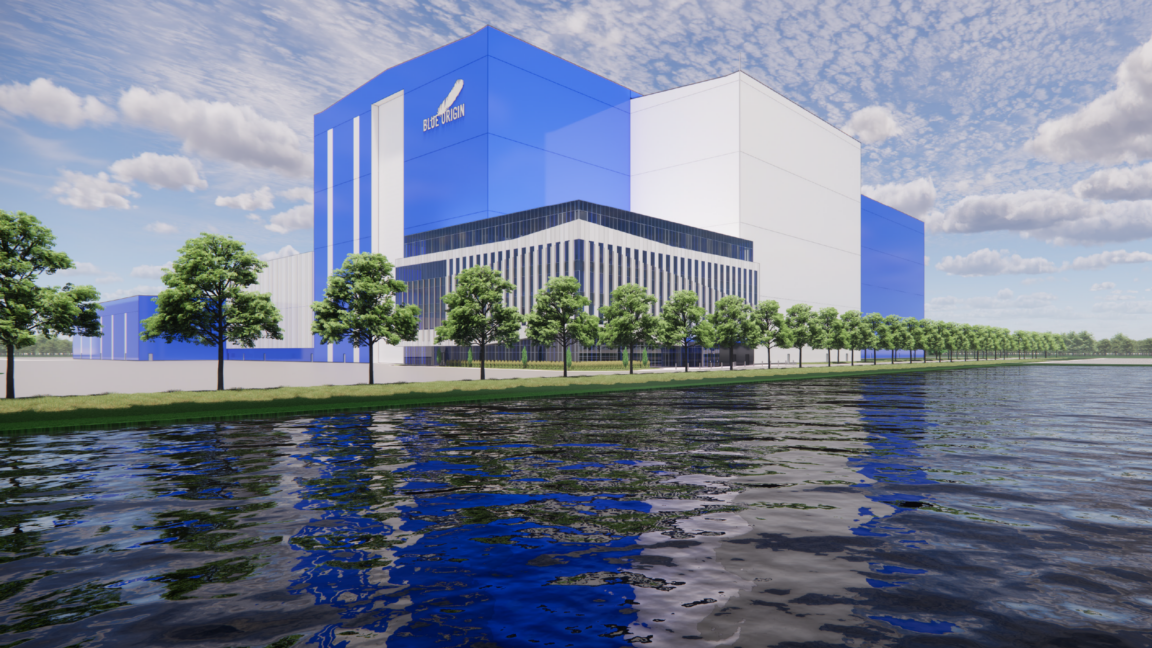
Blue Origin announced a major expansion of its already considerable Florida launch facilities on Friday morning with the intent of eventually flying more than 100 rockets a year from there.
The company said it would add two launch pads for the New Glenn rocket, in addition to two already under construction at Cape Canaveral. The company is also investing heavily in a new manufacturing facility that will produce up to 150 upper stages for a larger variant of the New Glenn rocket.
The company also plans to procure two additional landing ships to catch and return the first stage of the New Glenn rocket (it currently has one, named Jacklyn). Finally, Blue Origin said it would add a new customer integration facility, built in conjunction with the US Space Force, that will feature four payload bays to process multiple missions at the same time.
“These investments are centered on one goal: building the capacity to support more missions, more reliably, and more efficiently,” wrote Ian Richardson, senior vice president of operations at Blue Origin, in an update on the company’s website this morning. “As we look ahead, this infrastructure is designed to support multiple flights per week by the end of the decade.
$3 billion and counting
To date, Blue Origin has invested about $3 billion in facilities and infrastructure in Florida, largely to support the construction and launch of the heavy-lift New Glenn rocket. The company now has more than 5,000 employees working in Florida and 500 suppliers in the state.
“Our manufacturing and operations footprint has more than doubled in the last couple of years, now spanning more than 20 sites across Brevard and Orange Counties,” Richardson wrote. “Blue Origin is the only company—and the largest employer—to manufacture, launch, and refurbish rockets on the Space Coast.”
That would seem to be a reference to superseding the 800-pound gorilla on the Florida Space Coast, SpaceX, which has launched hundreds of rockets into orbit over the years from Florida. Blue Origin has launched to orbit twice.
But Blue Origin is expanding its rocket facilities, while SpaceX is pulling back from the commercial launch market with its Falcon 9 and Falcon Heavy vehicles. As Ars has reported, a growing launch crisis is emerging as commercial satellite customers have struggled to purchase a Falcon launch after 2028.
This has created an opening for medium- and heavy-lift vehicles that, if Blue Origin can get New Glenn flying successfully and frequently, it is poised to fill. The company’s previous investments, along with the new infrastructure, suggest Blue Origin founder Jeff Bezos is deadly serious about making this a reality.
Barreling back from BE-4 setback
After a promising start, the New Glenn rocket program was stalled in late May, when a problem with one of the rocket’s BE-4 engines led to the catastrophic loss of the vehicle and its only launch site, Launch Complex 36A at Cape Canaveral.
Since then, the company has been urgently rebuilding the site at 36A to support a return-to-flight mission for New Glenn before the end of 2026. While this is unlikely, the company appears on track to resume New Glenn launches during the first few months of 2027.
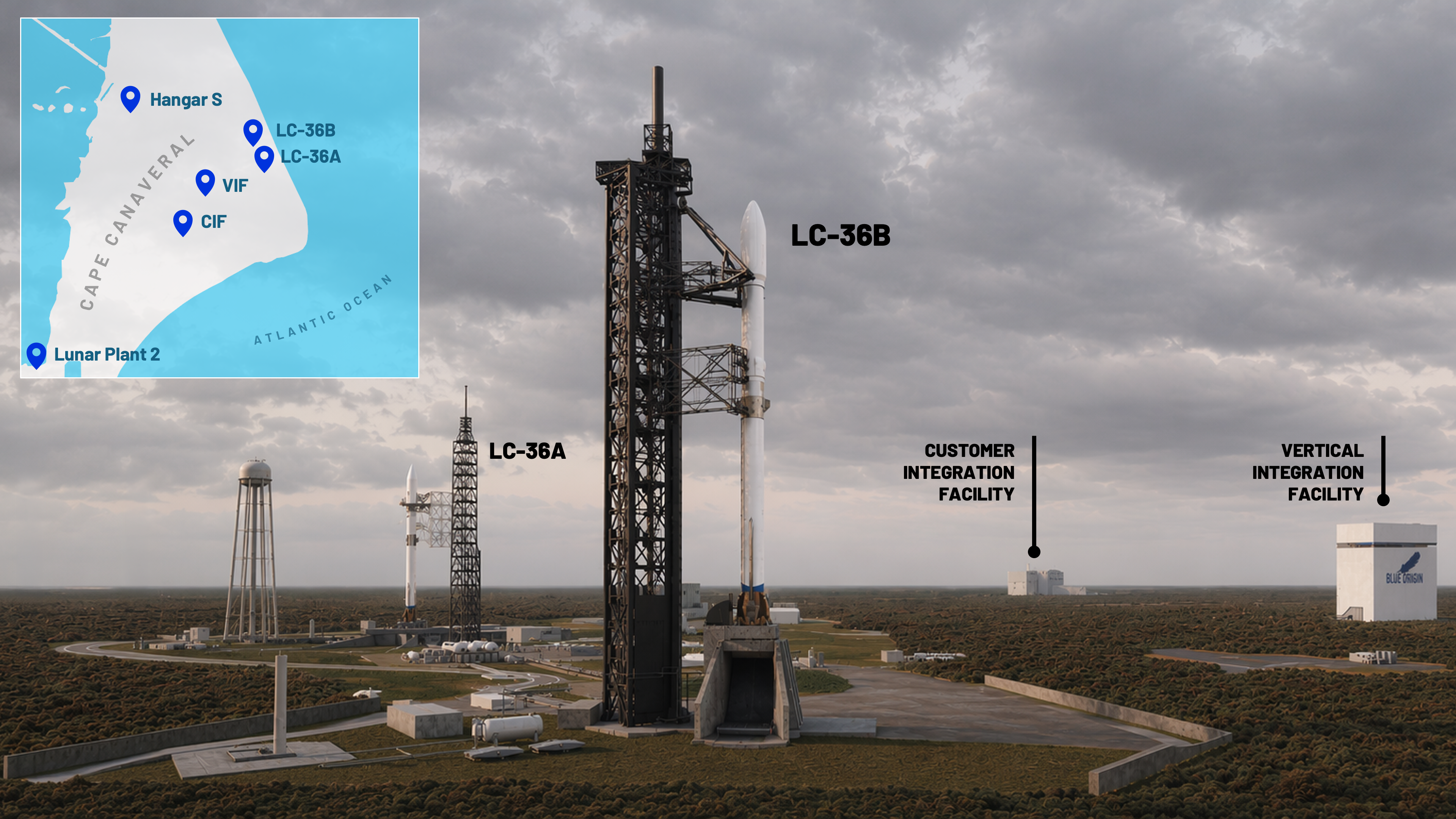
Blue Origin has previously announced its plans to rebuild 36A as rapidly as possible, as well as completing the nearby Launch Complex 36B site to support a larger version of New Glenn. This 9×4 variant of the rocket has nine first-stage engines compared to the smaller 7×2 variant, with seven engines.
The new launch pads announced Friday morning are likely intended to support the larger 9×4 variant. As Richardson wrote, “These pads will be rapidly sited and constructed by replicating the design and construction approach being demonstrated with the build of LC-36B.”
The 9×4 rocket is designed to carry 70 metric tons to low-Earth orbit, and more than 20 tons to trans-lunar injection. The company has not confirmed this, but Blue Origin likely needs the 9×4 variant as part of its plans to launch a human lander to the Moon for NASA as part of the Artemis Program. It could debut in 2028 if development goes well.