
The first order of business for the energy transition is electrifying applications like vehicles and heating and making sure that the electricity that powers them is made using renewables. But once the dominant slices of the emissions pie have shrunk, other categories with less potential to reduce emissions become important.
A new study led by Haiwei Zhou at the University of Melbourne focused on the emissions associated with making lithium-ion batteries, which many parts of the energy transition rely on. Those emissions aren’t zero, so as we use more and more batteries, that number will grow. Right now, the researchers estimate that these emissions only account for 0.18 percent of annual greenhouse gas releases, but they could increase by a factor of 10 or more by 2050.
Avoiding production
There are a number of ways to reduce the emissions required to make a battery. Some elements used in various lithium-ion battery chemistries are more energy-intensive to mine and refine than others. The battery manufacturing process involves many steps that could be made more energy-efficient. And then there’s recycling, which can put battery materials back into the loop while requiring much less energy than mining.
But the researchers wanted to compare options on the demand side of the equation. Rather than shaving the per-battery carbon footprint, this means reducing the number of batteries we need to make, avoiding their emissions entirely.
The team used projections of emissions throughout the life cycle of batteries used for electric vehicles (EVs) and energy storage through 2050. This includes regional differences in demand and electricity generation, using International Energy Agency scenarios for the future. The estimates of emissions savings, then, aren’t just compared to the current state of industries, but to industries in a future world with more batteries, more end-of-life batteries to be recycled, and a cleaner electrical grid.
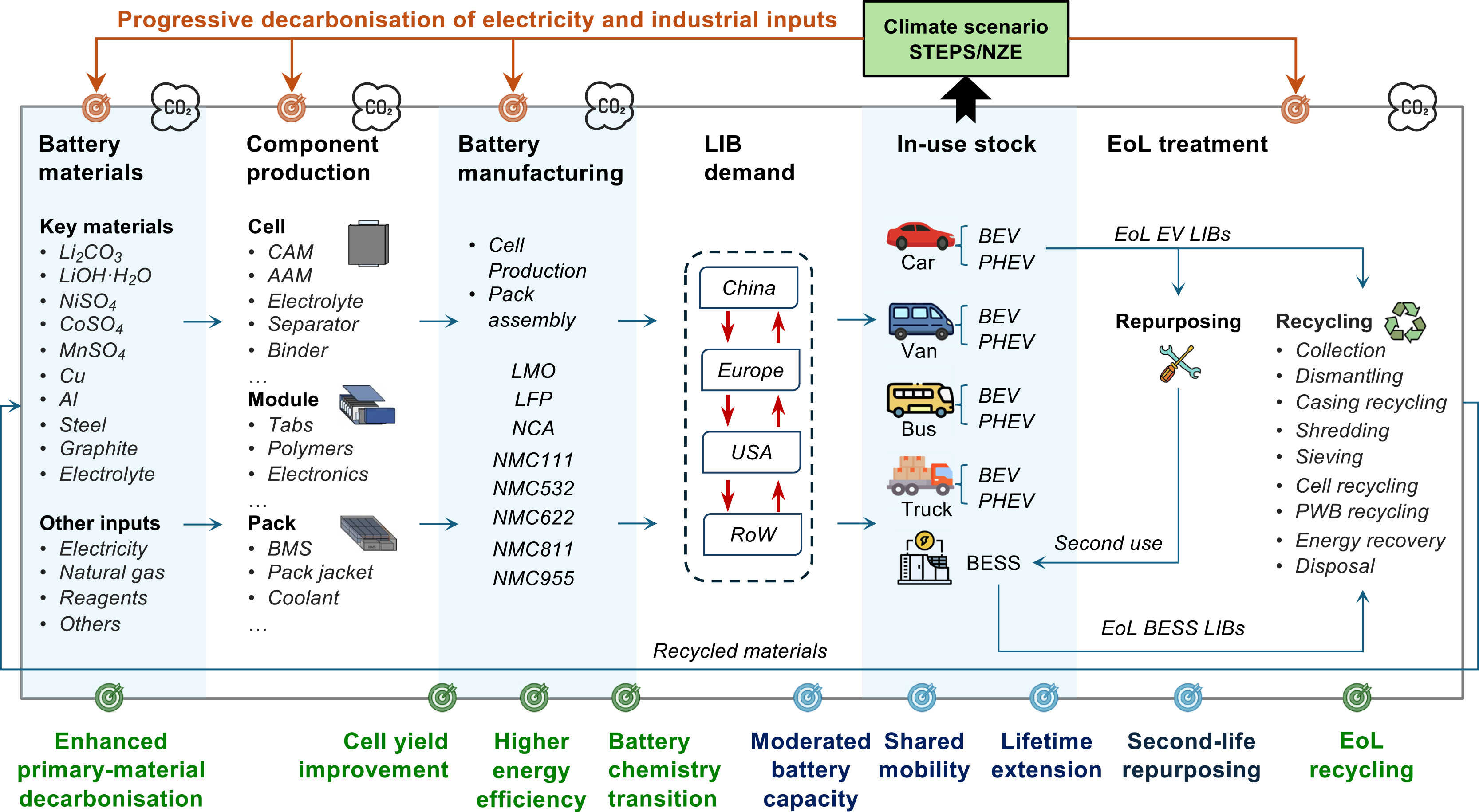
In total, efforts to clean up battery production could reduce the carbon footprint of a given battery by 34 percent by 2050, they found. Between 2024 and 2050, that would avoid somewhere between 3.5 and 4.7 billion tons of CO2.
Using batteries efficiently
Reducing demand isn’t a “just say no to batteries” story. There are simple strategies that limit the number of batteries you need to make. Ensuring that EV batteries last as long as the average vehicle reduces the need for replacements, cutting battery demand by 29 percent in this analysis. And limiting the ongoing growth in average EV battery capacity—driven by preferences for longer range and larger vehicles—could reduce demand by another 23 percent compared to the current trend.
Additionally, adoption of services like ride-sharing could reduce demand by almost 10 percent, while repurposing end-of-life vehicle batteries for energy storage could contribute another 8 percent.
Together, all of this would eliminate 6–7.2 billion tons of CO2 between 2024 and 2050—a fair bit more than the supply chain improvements. For context, burning fossil fuels produced about 38 billion tons in 2025. Battery production is a small slice of the emissions pie, but getting to net-zero emissions means tackling many small sources as well as the biggest ones.
There is a lot we can do to produce cleaner electricity and to reduce the environmental footprint of batteries. But the battery you don’t make has zero footprint, so the benefits of any reduction in demand add up fast.
One Earth, 2026. DOI: 10.1016/j.oneear.2026.101863 (About DOIs).