
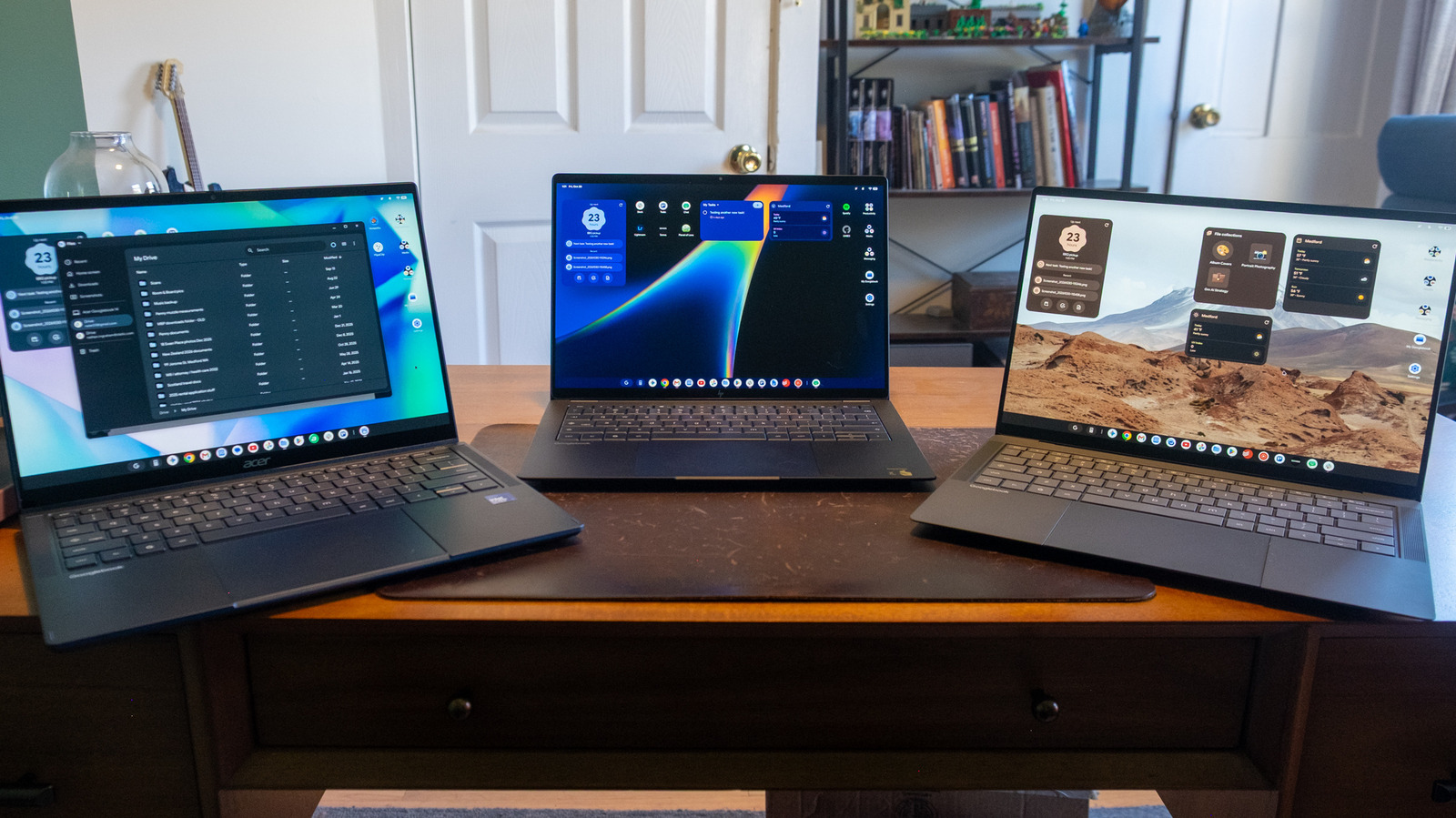
At this point, it's time to get into the value proposition here. As I mentioned at the top, Googlebooks are not cheap computers. All five Googlebooks are very well made with nice screens, good performance and relatively attractive industrial design. Strictly from a hardware standpoint, the $899 Acer is asking for its first Googlebook feels appropriate given its build quality and specs. Dell's $999 XPS Googlebook is also intriguing given its extremely compact size without skimping on performance, while HP's $1,199 Googlebook 14 is a premium laptop through and through, and it feels nearly as nice as most MacBooks.
But at these prices, particularly once you're over $1,000, you can spend a little more and get similarly nice, well-equipped Windows PCs or a MacBook Air — both of which run a far more useful set of software than a Googlebook. The promise of improved connectivity between your Android phone and laptop could absolutely be beneficial, but I'm not convinced it is in anyone's best interest to choose Gemini's AI features over the much more robust and battle-tested experience you'll get using a Mac or Windows computer.
That said, I'm looking forward to the evolution of Googlebooks. While the OS might not be fully baked yet, the fact that Google has both its desktop and phone platforms now running essentially the same software would make things a lot easier for development, as well as making the two categories of devices work even more seamlessly together in the future. Just as it did with Chrome OS, Google is offering a platform that could cover the basics for a lot of users in a relatively simple, straightforward package — if we get hardware at a wider range of prices and a more mature OS, that is.