
KENNEDY SPACE CENTER, Fla.—Blue Origin announced two significant upgrades to its New Glenn rocket on Thursday, reducing the cost of manufacturing the vehicle and expanding its capacity for payload delivery to geostationary orbit and the Moon.
With these upgrades, the company aims to eventually position New Glenn to launch more than 1,000 times a year.
“There has never been higher demand for launch, ever,” Dave Limp, chief executive officer of Blue Origin, said during the UP.Summit conference at the Shuttle Landing Facility in Florida.
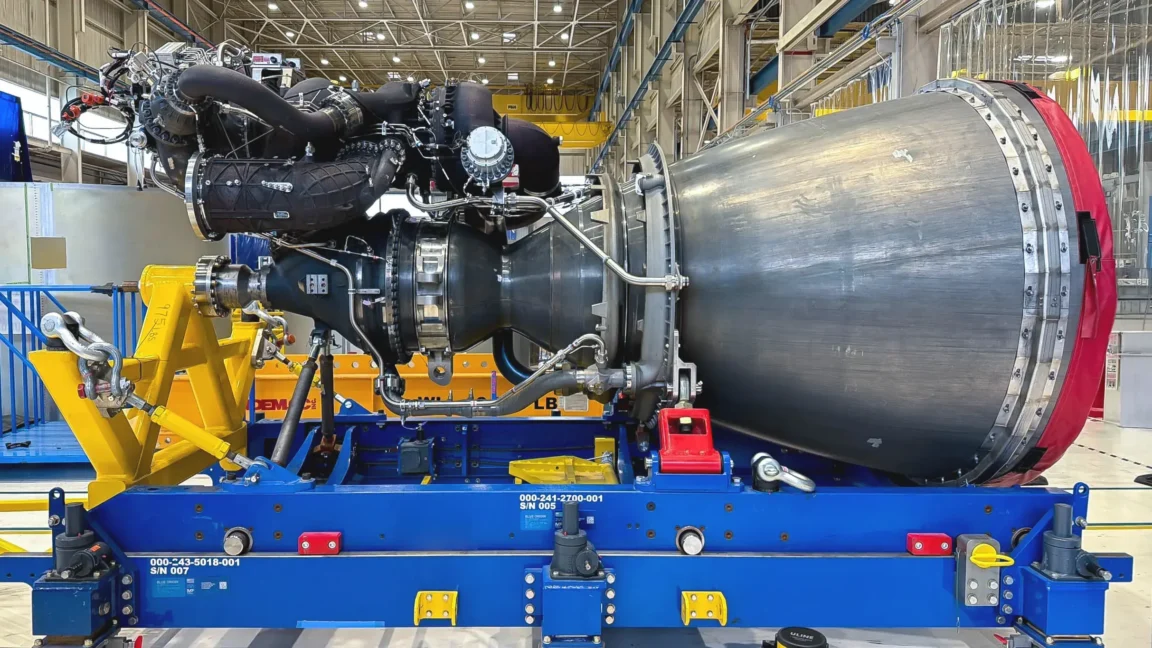
Blue Origin has already begun test firing a new engine, called Northstar, that will eventually replace the BE-4 engine that powers the first stage of New Glenn. Separately, the company also said it was developing a hydrogen-oxygen third stage for the rocket, GS3, to give it an extra kick.
A new Northstar
The Northstar engine is a simplified but more powerful version of the BE-4 engine, Limp said. It has half the number of parts, 30 percent less mass, and about 65 percent can be 3D-printed.
Blue Origin believes it can manufacture the engine at 25 percent of the cost of a BE-4 engine, and eventually reach the point where each engine can be assembled in less than a day. The company is deep into development and testing of Northstar, having already begun a test-firing campaign.
“To get access to space at a lower cost, we have to look at every part of the vehicle,” Limp said. “This is going to be a game-changer.”
The BE-4 engine powering New Glenn today has a thrust of 640,000 pounds, and Limp said Northstar will have a starting thrust of 715,000 pounds. Like the BE-4 engine, Northstar burns methane and liquid oxygen using an oxygen-rich staged combustion cycle and a single-shaft turbopump architecture.
Limp said the company will continue to manufacture the existing BE-4 engine for United Launch Alliance, which uses two of the engines to power its Vulcan rocket.
GS3 provides a nice kick
Blue Origin is developing a third stage for New Glenn called GS3 (creatively named Glenn Stage 3) to offer direct injection to geostationary orbit and Earth-escape trajectories. The third stage fits within an interstage, preserving the full fairing volume for customer payloads.
The stage can fly on both the smaller 7×2 variant (as in seven first stage engines and two second stage engines) of New Glenn as well as the larger 9×4 variant. According to Blue Origin, a GS3-equipped New Glenn 7×2 can carry 8 metric tons directly to geostationary orbit and 10 metric tons to translunar injection. Those figures increase to 14 tons and 20 tons, respectively, for the larger 9×4 variant.
As the rocket’s third stage, it needs to be light, Limp said. For this reason, the third stage is made mostly of composites, which are high-performing and lightweight. But there’s a problem with that.
The trouble with hydrogen
The stage will be powered by the company’s BE-7 engine, already used by its lunar landers. This engine is optimized for in-space operations and uses liquid hydrogen and oxygen propellants. But hydrogen is the smallest atom and therefore leaky. With composites, thermal cycling and mechanical strain can cause cracking, exacerbating losses of molecular hydrogen.
Limp said the company was not sure a large composite tank, 5.5-meter diameter in this case, could be constructed that would contain hydrogen at high pressures.
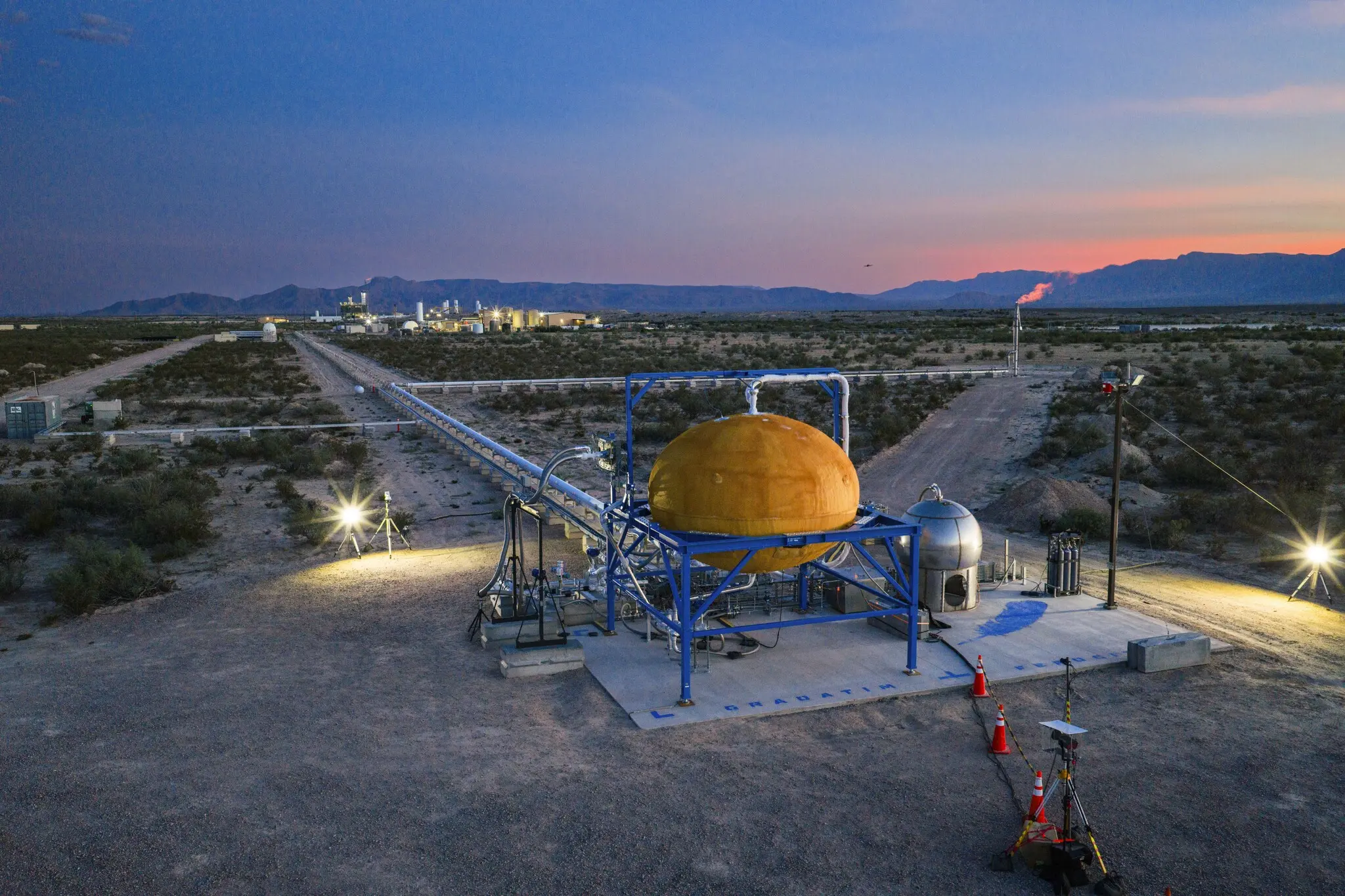
The company recently had a breakthrough at Launch Site One in Texas, when it completed its first composite liquid hydrogen tanking test. During the test, the tank was pressurized to 100 percent of the maximum force expected during operation for 2.5 hours. It was even successfully tested at 150 percent of this maximum pressure for 10 minutes.
That gave the company confidence that a GS3 based on composite tanks was a concept that could go forward, and now the company is aiming for a debut in 2028 for a government customer.
“We have one customer signed up for cislunar space in 2028,” Limp said. “We are open for business.”