
Several tanker ships linked to Iran have been loitering over subsea Internet cables in the Gulf of Oman near the Strait of Hormuz—a possible indication that the Iranian government is preparing to attack such undersea infrastructure in response to any renewed US and Israeli strikes.
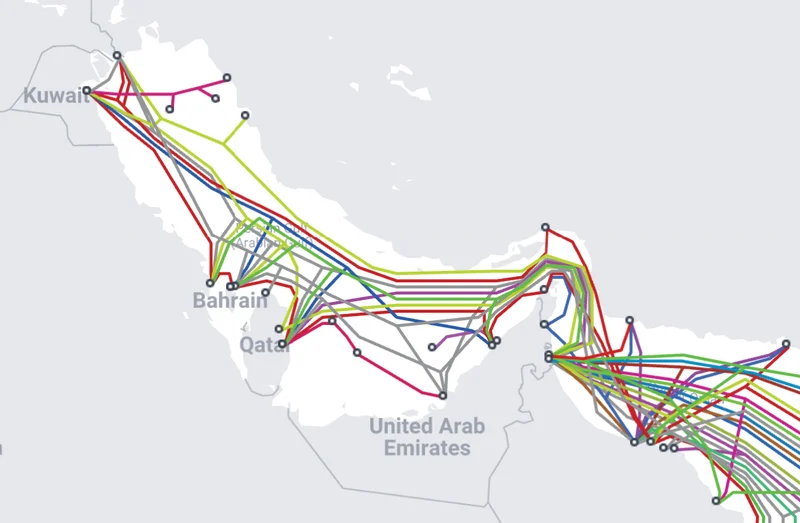
The movements of three sanctioned tankers and an Iranian fishing boat have been tracked near major undersea cables by the maritime intelligence firm Windward in October, according to the Financial Times. Six active cables currently cross through the contested Strait of Hormuz, linking the Middle East to Europe, Africa and Asia, with two more cables having segments under construction in the region.
Four countries, including Iraq, Kuwait, Bahrain and Qatar, depend entirely upon such subsea telecommunications connections running through the Strait of Hormuz chokepoint to link with the outside world. But other countries also depend heavily on the region’s undersea cable network—one third of India’s westbound Internet traffic goes through the Persian Gulf and Strait of Hormuz.
One cable under construction, the 2Africa cable, is owned by a tech consortium that includes the US company Meta. That was one of the major cable corridors visited by the drifting Iran-linked ships.
Windward used both ship-tracking data and satellite images to track the vessels as they slowed down and looped around near multiple cables, with some ships then “going dark” by switching off their automatic identification system (AIS) transponders that normally broadcast their location and other information.
Such movement and behavioral patterns suggest the Iran-linked ships may be “mapping the cable routes, or placing charges or mines on them while dark,” Windward told the Financial Times.
Windward highlighted the examples of two sanctioned tankers linked to Iran that spent days drifting “directly over regional cable corridors… both with no commercial reason to stop” in a blog post on October 26. Both ships carried no commercial cargo.
Threats of cable fees and attacks
Since the US and Israel first launched a major war with Iran in February 2026, Iran’s response beyond targeting US military bases, ships and aircraft has included attacking commercial shipping in the Strait of Hormuz and hitting oil refineries and other energy infrastructure along with airports in various Gulf countries.
Iran has also made a point of threatening or attacking US Big Tech infrastructure in the Middle East, including launching multiple drone strikes on Amazon data centers. In May 2026, a spokesperson for Iran’s Islamic Revolutionary Guard Corps claimed Iran would “impose fees on Internet cables” belonging to US tech companies and other owners.
But more recently, multiple Iranian officials and commanders of Iran’s Islamic Revolutionary Guard Corps (IRGC) have warned that they could directly attack the undersea cables running through the Strait of Hormuz. This came after President Donald Trump repeatedly threatened to renew major US military strikes on Iran and warned he could “annihilate” the country during a speech at the United Nations in New York on September 22.
“Seven major cables run through the Strait of Hormuz, supporting global Internet operations and commercial data transmission,” one IRGC spokesperson said on October 20. “We remind the enemy of this.”
The latest phase of the war has involved more limited US military strikes against Iranian targets, even as Trump has alternated between threats and touting the possibility of a diplomatic breakthrough. Meanwhile, Iran has increased drone strikes and other attacks on commercial ships to exert its own pressure on the United States, with October marking the highest number of ship attacks since the war began.
Much damage has already been done. The limited fleet of cable-laying ships used for installation and repair has not been able to venture safely into the region since the war began, which forced the Meta-backed 2Africa cable to pause its planned expansion. The war has also compelled US tech companies and Gulf countries to accelerate efforts to develop alternative cable routes bypassing the Strait of Hormuz.
The Middle East is not the only part of the world where threats to the Internet’s undersea backbone have intensified. Subsea infrastructure is increasingly at risk from sabotage and gray-zone warfare from the Baltic Sea to the Pacific Ocean.