
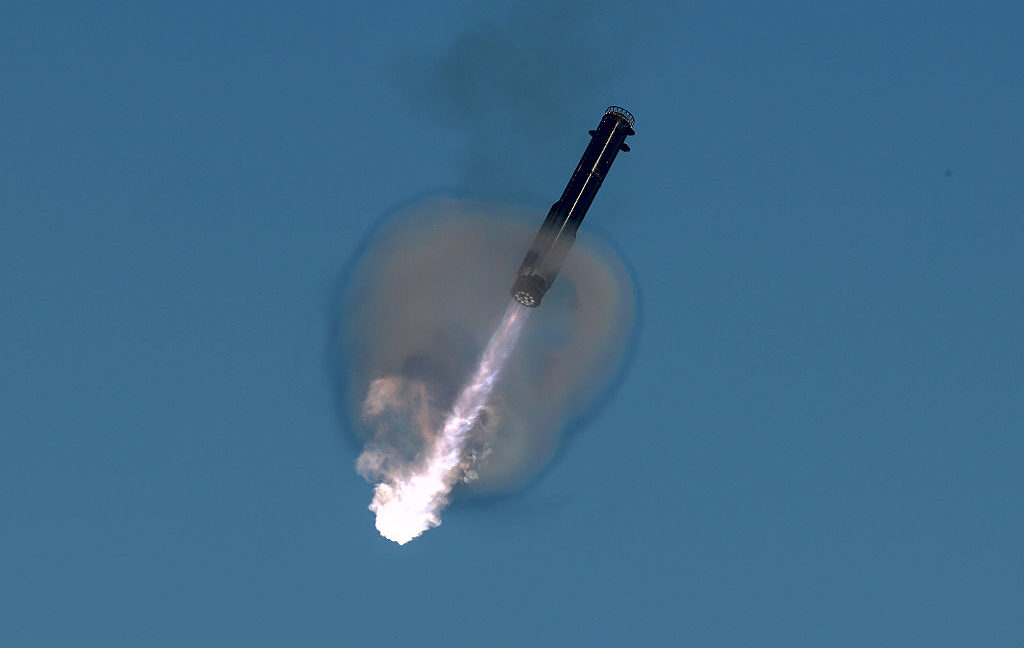
STARBASE, Texas—Starship lifted off right on schedule Friday from South Texas, making its 15th test flight in more than three years.
The largely successful launch took place in the early evening; as the massive rocket rose into the atmosphere, the Sun sank toward the western horizon. Conditions were ideal for the launch, with the atmospheric winds so calm the rocket’s white plume did not dissipate for many minutes. The weather in South Texas is not always comfortable; summers are long and hot. Friday evening was perfect at Starbase.
The first stage ascended toward space flawlessly, releasing the upper stage above the Gulf of Mexico. From there, the Starship upper stage ignited its Raptor engines and powered its way into a nominal orbit. This was the second time SpaceX has flown Starship into low-Earth orbit.
When it came time for the first stage to return to the ground, it dropped like a rock. However, due to an unspecified issue, the vehicle was commanded to divert into the Gulf rather than return to the Starbase facility to be caught by the launch tower. It created a fantastically powerful explosion, even for observers more than 10 miles away.
Primary mission, a success
The primary aim of Friday’s launch was the deployment of 26 Starlink V3 satellites from a narrow door at the base of the spacecraft. This occurred about 40 minutes into Starship’s flight, and all 26 satellites—which have solar panels that stretch 60 meters end to end when fully deployed—safely made it into orbit, where they will now use onboard propulsion to raise their altitude.
This means that Starship is now an operational, orbital rocket. It is the largest and most powerful machine humans have ever launched into space. The challenge for the company now is to make Starship reusable and dramatically increase its flight rate.
In that sense, the first part of Friday’s mission was not a success. SpaceX had hoped to return the first-stage booster, refurbish it, and fly it again. The company has previously landed and reflown Starship boosters but has yet to do so with the latest iteration of the vehicle, version 3.
However, SpaceX still has a chance to make history on Saturday with the potential return of the Starship upper stage. SpaceX has never attempted to catch the vehicle’s upper stage.
Doing so will require Starship to pass a series of tests in orbit and subsequently during its return to Earth to ensure it is fully healthy. This is critical because Starship will be passing over parts of Mexico and the United States before returning to Starbase, and SpaceX does not want to endanger people on the ground. Additionally, it does not want to risk damage to its launch towers.
If Starship passes these health checks, it would land at about 3:15 pm local time in Texas (21:15 UTC). If it does not, the company has earlier options to de-orbit the vehicle into an ocean.
Testing the heat shield is critical
Successfully returning Starship’s upper stage would be historic, as well as significant for SpaceX’s efforts to reuse the massive rocket. It would also give the company valuable information about the vehicle’s performance during reentry.
One of the biggest hurdles left in Starship’s development is the vehicle’s heat shield, which must protect the upper stage during its return through Earth’s atmosphere. More than that, SpaceX aims to make Starship rapidly reusable, and to do this, Starship’s tiles must be light and resilient.
SpaceX has been experimenting with tiles since the beginning of the Starship program, trying to find the right combination of low mass, heat resistance, and durability so the tiles require minimal refurbishment between launches. For this flight, SpaceX said it is applying learnings from the previous test flight in September, including additional retention mechanisms on tiles in areas deemed to be at the highest risk of falling off during ascent and addressing areas with a flow path for plasma to get behind the tiles.
Another problem on recent flights has been heat incursion into the small gaps between the edges of the tiles. According to SpaceX, this Starship has a large portion of the heat shield equipped with a curved tile design that has shown the ability to reduce heating in the gaps between tiles.