
Google announced Android developer verification last year, and despite numerous objections from developers and users, the company is forging ahead. It began blocking the installation of unregistered apps in some countries this fall, and the system is expanding globally soon. Google says it will start rolling out the requirement in all regions in January 2027, and it urges devs who still haven’t registered their apps to do so soon.
The apps you download from the Play Store all come from verified developers, and Google’s new requirement expands that requirement to apps from third-party sources. Once developer verification is live in your region, you won’t be able to sideload apps unless the developer has registered with Google, which is framed as a security measure. Verification requires providing government identification and paying a $25 fee, which will allegedly make it harder for nefarious actors to distribute malware and scammy apps.
In September, Google launched verification in Brazil, Indonesia, Singapore, and Thailand. Apparently, nothing exploded, so the company is now ready to expand. It previously said verification would go global in 2027, and it’s not wasting any time with the January start. It says that verification will reach all devices within “several months.”
So far, Google is getting what it wanted from this initiative, with “millions” of non-Play apps already registered. The company says this accounts for more than 99 percent of global Android app installs.
The verifier system service has already been rolled out to Google-certified devices running Android 8 Oreo or higher, which accounts for just about every Android device in the world outside of China and Russia. Google has also partnered with the biggest third-party app stores to enforce verification: Galaxy Store, Honor, Oppo, Xiaomi, Transsion, and Vivo. The system-level verifier is responsible for blocking installs, but these stores will only list verified apps once Google flips the switch.
Feedback accepted
Google has gotten a lot of feedback since announcing this change, and it has listened to some of it. Hobbyists will be able to register a free account to distribute apps to a small group. Google initially planned to limit this to 25 total installs, but that has since been increased to 50 installs. There’s also now an API that developers can use to streamline registering new application packages.
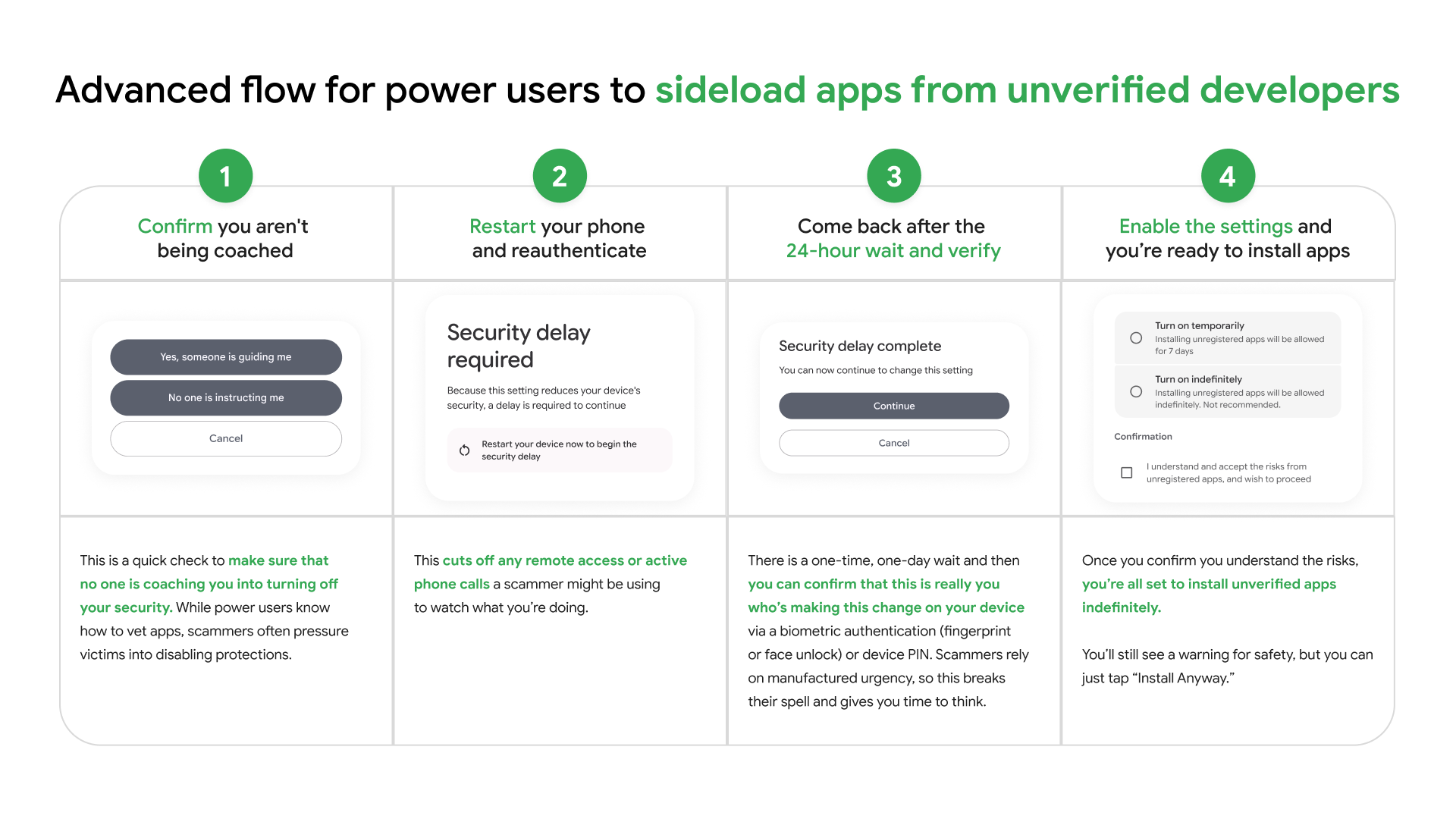
Google also relented and created an opt-out system for users who don’t want their installations limited. The so-called “advanced flow” will let you install whatever you want regardless of verification status, but it’s not a simple toggle. The option will be buried, and there will be plenty of scary warnings about the risks. You’ll also have to wait 24 hours to fully activate the feature. This setting is already live, so you can tell your phone to ignore verification right now.
Even if Google has managed to make verification a little more warm and cuddly, it still gives the company a lot more control. Developers in sanctioned nations won’t be able to verify their identities, locking them out of app distribution. Sideloading an app may also require a Google server connection. Only popular app IDs will be cached on devices for verification purposes. For others, your phone will have to check with Google before installing. These will be edge cases, certainly, but still very annoying ones.
As Google moves toward full verification enforcement, it has created guides for developers and app distributors to outline all the salient points. These guides suggest Google expects verification to be fully online by March 1, 2027.