
Much of the focus for human-caused climate change is on fossil fuels, which are creating most of our problems. But land use change is also a large component of the story, accounting for about one-third of total historical CO2 emissions. Deforestation plays a major role here, but practices like draining wetlands also factor in. Exactly how much of our history of eliminating wetlands has contributed to warming is challenging to figure out. But thanks to new sources of data that measure emissions from today’s surviving wetlands, it’s possible to put a better number on it.
A new study led by Jevan Yu at MIT focuses on peatlands—environments like bogs and fens where organic matter accumulates into thick layers of material. Some 600 billion tons of carbon are held in these vast stores of peat, which is more than you can find in all the world’s living vegetation, the researchers note.
Because these areas are permanently inundated, any oxygen in the water is quickly used up, leaving the job of decaying all that organic matter to anaerobic bacteria that work much more slowly and don’t digest everything. So instead of seeing organic carbon turning into the CO2 gas released by aerobic bacteria, in peatlands, a subset of it gradually turns into methane gas. Methane is an even more potent greenhouse gas than CO2 itself and ultimately gets oxidized into CO2. That means there’s a little trade-off from peatlands—most of the carbon they have is kept out of the atmosphere, but the carbon that does escape does so as methane.
Many peatlands have been drained by digging ditches that let water flow out to repurpose the land for agriculture or other uses. That lowers the water level, supplying oxygen to the exposed peat and ringing the aerobic bacteria dinner bell. Methane emissions get turned down, and CO2 emissions get turned way up.
History re: peats
The researchers used recent studies that measure gas emissions from peatlands to build a global model that estimated CO2 and methane release as the water level drops. The two gases respond differently to a given drop in water level, and CO2 in particular responds differently depending on where in the world the bog is located. Using reconstructions of water-level changes due to historical peatland drainage, the team ran their model starting in 1800.
The simplest way to represent the climate impact of both CO2 and methane changes was to calculate the change in Earth’s energy budget—the strength of the greenhouse effect, in other words. They calculated the total effect in 2020 at about +83 milliwatts per square meter of the Earth’s surface from the CO2 emissions, and about -9 milliwatts per square meter from the reduced methane emissions, for a total effect of +73 mW. That is 2.7 percent of the total human-caused change in Earth’s energy budget. (With the error bars on all these numbers, it’s 1.8–3.6 percent.)
Or to look at it another way, it means that around 4 percent of all the carbon that was buried in peatlands is now in the atmosphere.
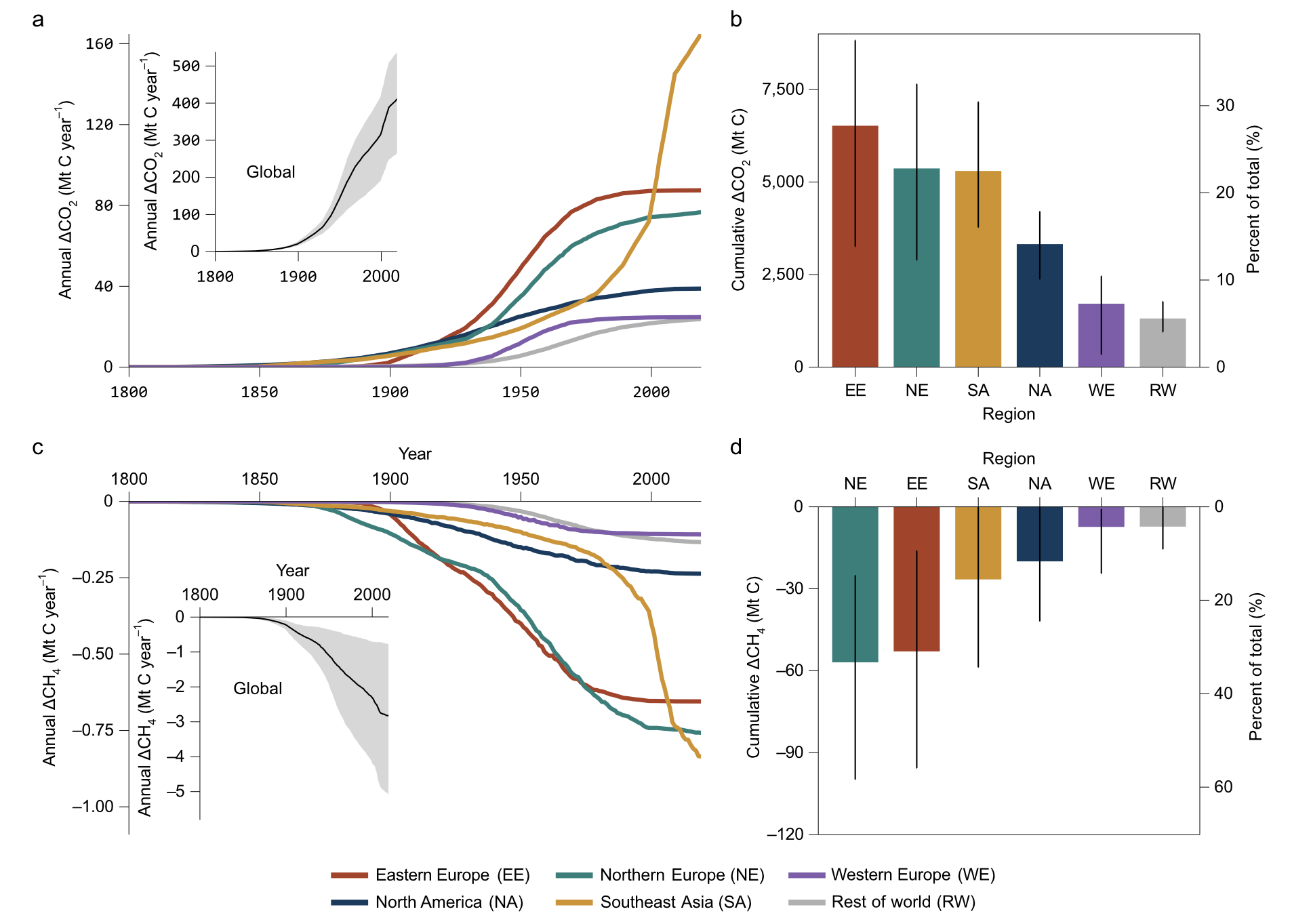
Regionally, over half of the total CO2 came from Europe, almost a quarter came from Southeast Asia, and only 14 percent came from North America. The timing is quite different, as well, with the contribution from Southeast Asia only jumping up in the last few decades.
Draining a peatland only starts the process of releasing carbon, though. So that means past land-use change will still be producing emissions in the future. To examine this, the researchers also ran their model forward to 2100.
If peatland water levels were simply held constant from 2020 on, the total change in Earth’s energy budget would nearly double, from 73 to 138 milliwatts per square meter by 2100. Moderate restoration of peatland water levels could reduce that growth, and ambitious restoration could even cause the effect to shrink slightly below its 2020 potency in their analysis. This is a process we can halt if we really want to.
But since rolling all the way back to the landscape of 1800 is unlikely, elevated emissions will continue for a long time. That makes this another part of the climate system where change plays out slowly, with long-term consequences.
Nature, 2026. DOI: 10.1038/s41586-026-11339-0 (About DOIs).